Bourne Estate

A single-storey brick building with a fenced yard to one side, containing two trees and a bike shelter.
Bourne Community Hub; a key project for Bourne Big Local (credit: Richard Crease)
Poole, South West 
Awarded £1,199,500 of Big Local funding from 2012 

Key points

  • Working with the council and contractors, the partnership developed a new community centre where residents could access support agencies and organisations.
  • Residents were regularly engaged through events such as low-cost family-friendly activities and affordable Tea and Toast’ drop-in events.
  • The local environment was improved by developing several parks and recreational areas and addressing fly-tipping and litter.

About the Big Local area

The Bourne Big Local area covered a residential area in the north-east of Poole, Dorset, four miles from both Poole and Bournemouth town centres. In 2021, it had a population of just under 4,000 people (ONS, 2022a). The partnership described Bourne as an anomaly compared to the rest of Poole as the population was young, with only 10 per cent of residents aged 65 and older compared to 23 per cent in the rest of the town (ONS, 2022b). The area had 32 per cent of children (aged 0–19) living in low-income families (DWP, 2024), compared to 15 per cent in Poole. At the time of Big Local, there were shops and – situated on nearby Rossmore Campus – a secondary school, library, leisure centre and a children’s centre.

How the Big Local area approached delivery

The Bourne Big Local partnership aimed to empower residents and work alongside partner organisations to improve community spirit and safety, bring about cleaner streets, and provide support to the community.

Throughout their Big Local work, the partnership gave residents a platform and advocated for what the community felt was needed in their area. For example, following consultation with young people, the partnership allocated funds to a skate park. They also worked to reduce littering, highlighted by residents as a recurring issue. Alongside regular community feedback, the Bourne Big Local partnership ran a community chest grant scheme and connected residents with public agencies operating in the area, such as Citizens Advice.

The partnership found it difficult to secure a paid worker to support delivery long-term and became aware of the limitations of how much they and other volunteers could deliver. To increase their capacity, they commissioned others to deliver specialist activities and services, such as mental health support, youth work, and financial advice.

They worked closely with two existing community organisations to support on larger projects. Bourne Community Group, a voluntary organisation, supported them early on with events and community engagement. The partnership also worked closely with Poole Communities Trust to fundraise, project manage and construct Bourne Community Hub.

A Big Local partnership was a group made up of at least eight people that guided the overall direction of delivery in a Big Local area.

Many Big Local partnerships funded workers to support the delivery of Big Local. They were paid individuals, as opposed to those who volunteered their time. They were different from Big Local reps and advisors, who were appointed and paid by Local Trust. 

What the Big Local area did

Community assets and spaces

Developing a new community hub to meet residents’ needs

With an existing youth centre in disrepair, and facilities at Rossmore Campus a 25-minute walk away, Bourne residents found it difficult to access community activities and services. Inspired by other Big Local areas, the partnership committed to support the development of a new purpose-built community space in partnership with Poole Communities Trust. Big Local funding contributed £600,000 to the project, which cost around £2.1 million in total. 

The Bourne Big Local partnership was involved in the hub’s planning and development. To guide decisions and ensure the hub would continue to meet residents’ needs after the Big Local programme ended, a resident-led steering group set up a Memorandum of Understanding with Poole Communities Trust. It sought to ensure that the hub would remain open and affordable; offer services for specific groups (older residents, those not in employment, families, young people, and people who live alone); and that organisations could only hire the hub if done so regularly and for the benefit of residents.

The steering group is there to make sure the Hub continues to be about the community and not just about generating income. It’s important that it continues to provide things that are free of charge to local people.” 
Resident 
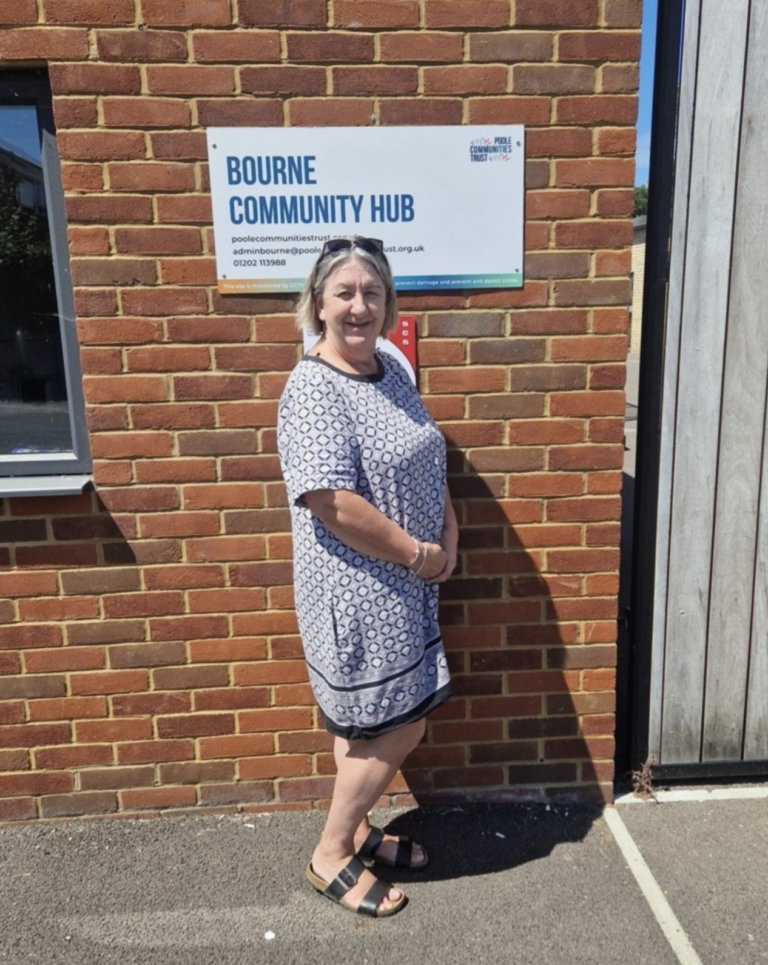
A single-storey brick building with a colourful sign above a wide glass entrance saying 'Bourne Community Hub'.
Entrance to the new Bourne Community Hub (credit: Richard Crease)

Big Local funding was used for a temporary modular building called the Mini Hub while the main site was under development. The partnership ran small events and activities to engage the community, volunteers and organisations ahead of the main hub opening. The Mini Hub was also used as a polling station, and a food hub during the Covid-19 pandemic.

The Bourne Community Hub opened in 2022, under the ownership and management of Poole Communities Trust. A 98-year lease from the council ensured the long-term future for the hub. The Hub was well-situated, being on a main road and next to a bus stop. By 2023, it housed a 50-place pre-school, activities for young and older people, and provided access to services and organisations such as Narcotics Anonymous, Citizens Advice, physical rehabilitation, and a group for mothers. The Hub also hosted Tea and Toast’ and a community pantry, which helped bring people through the door for the first time. Having multiple services and agencies under one roof made it easier to signpost residents to support.

Because there are a number of different groups operating at the Hub they can all share information. There was a woman who had recently lost her husband, she came to bingo and from that found out and now comes along to the tea and toast sessions every week.” 
Resident 
A row of glass-fronted fridges, stocked with food, with a woman and two children with shopping bags.
Community pantry located at the Bourne Community Hub (credit: Richard Crease)

Place-based pride and connection

Organising community events to reach different groups in the area

The partnership used community events to consult residents on their needs, engage them in Big Local activities and connect them with services in the Bourne area. Over time they learnt what sort of events, and activities at those events, worked best to engage different groups.

In the first year of delivering Big Local, the partnership hosted four large community events (including a fun fair), which demonstrated what the partnership was capable of to residents and local organisations. Although these events brought the community together, the partnership reflected they required a lot of funding and volunteers. 

The partnership also ran smaller events, where residents could be easily signposted to support agencies. For example, with safety raised by the community as a key issue, the partnership hosted events that brought the police, local authority and residents together to discuss the topic. This led to positive feedback from the police and local authority who felt they gained a better understanding of the issues residents faced and how they could better support them. 

The Bourne Big Local partnership reflected how low-cost, family-friendly events helped them build relationships with traditionally excluded residents, such as Gypsy and Romany Traveller communities. This helped some residents to later access services at the community hub.

Improving the local environment and increasing community pride

Residents shared concerns about fly-tipping, litter and streets feeling unsafe. The Bourne Big Local partnership wanted to make streets cleaner and change residents’ behaviour and perceptions of the area.

Big Local funding was invested in a skate park, a Multi-Use Games Area, and two play parks with grass areas for families to sit and have picnics. The partnership felt this provided spaces that the community (particularly young people) could be proud of and want to preserve.

By bringing together generations and giving young people something to do by funding equipment and activities, the Big Local is helping break down stigma on the estate.” 
Resident 

The partnership improved areas known for fly-tipping – having collected over 50 bags of rubbish themselves, they commissioned a local organisation to finish the task. To help reduce further littering, the organisation raised funds to buy plants and gave them away at Big Local events to encourage volunteers to plant bushes in the fly-tipping area. The partnership also worked with a local housing provider and local businesses to install skips and bins at locations where residents felt litter and fly-tipping was particularly bad. Big Local funding was also used to purchase equipment for residents to organise their own litter picks.

With the support of the Big Local partnership, Bourne residents worked together to keep streets and green spaces clean. The partnership saw this as evidence of their success in furthering community pride and positive perceptions of their area.

A sandwich board saying 'Cafe Open' in front of a single storey brick building and green steel-framed play area
Multi-use games area located at the new Bourne Community Hub (credit: Richard Crease)

Working collaboratively

Learning how to manage projects and partner relationships

By working with and commissioning other local agencies and organisations, Bourne partnership members developed their skills around managing projects and adapting to changing local contexts. For example, early in their Big Local journey, the partnership commissioned work to improve communal green spaces. Progress was slow and the partnership felt they had to manage the project more closely than they had expected. They learnt how to monitor contracts, manage project risk, and end contracts that were not meeting objectives.

The partnership also learnt how to manage relationships with the local authority. Early on, they had a positive relationship with Poole Council, who maintained the skate park and provided them with in-kind support from a community development worker. However, Poole Council merged with other councils in 2019, and the Bourne Big Local partnership reflected on how staff changeover and restructuring created communication challenges. 

Overall, the partnership reflected they achieved more by partnering with other organisations, and effective relationships helped them to increase their capacity.

How the Big Local area spent their funding

Each Big Local area received approximately £1.2 million (ranging from £1.199 mil to 1.209 mil) to spend over 10–15 years, depending on how much additional funding they accessed from Local Trust to address specific needs. For example, to bring people together at the start of the programme or to access training and support. This has been categorised for areas and at the programme level based on reports received from areas.

Partnerships chose their own priorities and categories for reporting, and were encouraged to use broad categories so they could use the funding flexibly. All areas spent a significant amount of money on Big Local delivery costs’ such as workers’ salaries, stationery and IT equipment. You can find out more about programme level spend in this article. This is how Bourne Estate Big Local told Local Trust they used their Big Local funding.

Bourne Community Hub
58% 
Young people
16% 
Big Local delivery costs
9% 
Community engagement
9% 
Community chest
5% 
Community safety and the environment
3% 
Source: Bourne Estate area plans and spend reports

References

Department for Work and Pensions (DWP) (2024) Children in low income families: local area statistics’. (Accessed 23 January 2025)

Office for National Statistics (ONS) (2022a) UK Census 2021: All persons’. (Accessed 23 January 2025) 

Office for National Statistics (ONS) (2022b) UK Census 2021: Age structure of the population: Aged 65 years and over’. (Accessed 23 January 2025)