Leigh Neighbours - Leigh West

An enclosed green space with a grey path through the centre, green metal fencing and hedge
Jubilee Community Garden; a Leigh Neighbours project (credit: Orrin Saint-Pierre)
Wigan, North West 
Awarded £1,209,500 of Big Local funding from 2010 

Key points

  • The partnership supported local schools to improve young people’s opportunities and mental health.
  • Access to safe and well-maintained housing was improved for local people, through the purchase of two properties.
  • Local people were involved in improving their environment through a community garden, organising planters on the streets, and growing food.

About the Big Local area

Leigh is a small industrial town close to Wigan. The Leigh West Big Local area included a population of around 3,000 people (ONS, 2022), and comprised of mostly residential housing with a few retail and business areas (Railway Road and Leigh Road). A significant number of properties were rented from private landlords – more than double the average in North West England (ONS, 2023 – with the value of houses for sale being significantly lower than the regional average (Land Registry, 2024)). 

At the time of Big Local, a paved civic square was surrounded by the town hall, parish church and public library. The community felt the area lacked significant public green and recreational spaces. Compared to regional figures, fewer people in the area reported being physically active (Sport England, 2023). In 2020, life expectancy for both men and women in the Leigh area was below the national average (OHID, 2022a; 2022b). Among other areas of civic pride, Leigh residents were proud of the town’s Rugby League successes.

How the Big Local area approached delivery

Unlike other Big Local partnerships, Leigh West Big Local was not formed from scratch, but developed out of a pre-existing group, the Leigh Neighbours Project. This group received funding to support community relations and cohesion between 2009 and 2011, before Big Local was launched. 

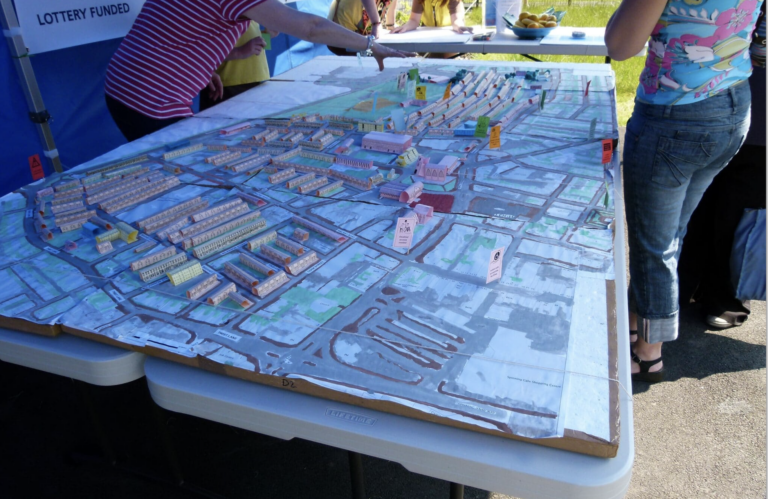
Throughout their time as a Big Local partnership, time and resources were invested in different types of community consultation to inform their work. This enabled residents to participate, and created a thorough understanding within the partnership of local issues and concerns. Early on, they commissioned a participatory, hands-on consultation method known as Planning for Real to identify and address need in the area. Using a 3D model made by a local school, residents were invited to show how they felt the area could be improved and suggest ways to address specific problems. Over 2,500 suggestions were received from more than 750 people.

The partnership recognised their broader role in the community as one of example-setting, which they saw as encouraging people to come together and practice collective decision-making. When Leigh West’s first plan was written at the start of the programme, residents made their five priorities for the area clear. They wanted the area to be safer and healthier; and clean and green. They wanted to see more employment and work experience opportunities, especially for young people, whom they felt lacked a positive future to look forward to. They wanted properties to be kept in good condition, and for sale and rental prices to be competitive. Finally, they wanted to see more community spirit, with people from all backgrounds mixing, getting on, and respecting each other. Residents felt that racially motivated crimes (including assault, harassment, and graffiti) reflected a lack of social cohesion in the community. The partnership reflected on what the community was experiencing and responded to it as needed, rather than always sticking to the plan. 

The partnership faced challenges in engagement during the programme. For example, decreasing interest from the community after the Covid-19 pandemic, which was attributed to people staying at home more. In deciding on their focus beyond Big Local, it was important for the partnership to recognise where past engagement had been more successful. This included public celebrations (such as the Queen’s Platinum Jubilee and VE day); community arts projects; collaborative work with local organisations and schools; an Active Travel proposal (encouraging residents to walk and cycle more); and sourcing external funding for continued project and activity delivery.

Leigh West was the first Big Local area to establish their own Charitable Incorporated Organisation (CIO), which was set up by the partnership in 2015 to act as their locally trusted organisation (LTO).

A Big Local partnership was a group made up of at least eight people that guided the overall direction of delivery in a Big Local area.

A locally trusted organisation (LTO) was the organisation chosen by people in a Big Local area or the partnership to administer and account for funding, and/​or deliver activities or services on behalf of a partnership. Areas might have worked with more than one locally trusted organisation depending on the plan and the skills and resources required.

A Big Local Plan set out what changes the partnership planned to make, how they planned to deliver on this and how funds were to be allocated. It was written for themselves, their community and Local Trust, as a guide and action plan.

What the Big Local area did

Community assets and spaces

Promoting good practice in housing

Responding to poor local rental conditions, Big Local funding was used to purchase two houses through the Leigh Neighbours Charitable Incorporated Organisation (CIO). The CIO was set up to purchase the houses, as the organisation that would host the community work beyond Big Local and continue to apply for and attract funding. Trustees were mainly drawn from the existing Leigh West partnership, with a few volunteers from the community, including a local café owner.

The houses were refurbished to a high standard, promoting good practice to private landlords, and providing Leigh West Big Local with a rental income for developing community projects in the long-term.

Leigh Neighbours CIO used the council’s Ethical Letting Agency to let the houses. It managed both properties and sets of tenants. The properties were let below market rate, common agent fees were scrapped, and repair and maintenance were all included in the rent. Partnership members and CIO trustees felt the Ethical Letting Agency’s ethos (to settle tenants in local properties for as long as possible, with five-year leases available) aligned with their own, and believed this would engender community stability, spirit and neighbourliness.

More generally, the partnership worked with the local council to see the appointment of a Tenant’s Champion to support residents with housing issues in the community. This involved encouraging residents to report issues with properties in the neighbourhood to Leigh Neighbours CIO through a postcard. The Tenant’s Champion then collated their responses and shared them with officers in the Council’s Housing Section to identify improvements that could be made.

Improving and changing perceptions of the area 

Through consultation, residents of the Leigh West Big Local area expressed desire for the local environment to be improved. Big Local funding was invested in sprucing up local streets, including through planting projects inspired by Incredible Edible – an urban gardening initiative dedicated to turning disused land into growing space. The projects made steps towards the desired improvements, while providing opportunities for residents to learn new skills around planting and growing food. The funding helped develop a patch of disused local land, creating a community garden that became a centrepiece in the community, maintained and cared for by local people. It also produced food, with surplus produce being donated to the local foodbank.

Partnership members felt that engaging residents in these environmental activities brought families together in ways they wouldn’t have before and increased pride in the area. A fund for residents, groups, and organisations led to other environmental improvement projects, including hanging baskets, spring bulb planting, alleyway greening, and a greenhouse for an infant school.

Two-storey red brick houses with trees and flower pots alongside the tarmacked road
Environmental improvements along residential streets in Leigh (credit: Orrin Saint-Pierre)

Place-based pride and connection

Involving residents in improving the local environment

Leigh West Big Local focused on making positive changes in ways that involved the local community. They worked with residents to design and install a variety of public artworks. These included works showing local scenes by local children, displayed on safety bollard wraps, and a wall of fame’ celebrating achievements of people from Leigh. 

The partnership also ran a Butterfly Campaign, featuring butterflies of all shapes and sizes created by residents using many different materials, as well as murals and hanging baskets. The campaign helped raise community spirits during the third national lockdown in early 2021. In a similar vein, in Autumn 2021, the partnership organised a Scarecrow Festival, for which residents, schools, and businesses contributed hand-made scarecrows to display around the village.

A brick wall with mounted colourful circular plaques
Wall of fame’ in Leigh (credit: Orrin Saint-Pierre)

Supporting people to live together in the community

The Leigh West partnership reported that some long-term residents expressed frustration, as they felt new residents were being offered advantages that long-term residents weren’t. Following reports of building racial tensions on one street, the partnership brought in the Peace Centre (a foundation based in Warrington, Cheshire) to conduct community mediation, supporting residents to find ways to live alongside each other. The partnership supported this work by introducing neighbours, hosting coffee mornings, facilitating consultation in different venues, and publicising events and activities. The partnership felt this area of their work significantly improved community relations.

“[We] wanted to work with the Peace Centre in Warrington for the mediation and the council wouldn’t have done it so well. This was another big tick for the legacy.” 
Partnership member 

Investing in young people

Improving outcomes for local children

Working with local primary school leaders, Big Local funding was allocated for two play therapists and sensory workers to help improve children’s mental health and wellbeing in two local schools. The Leigh West Big Local partnership felt the additional support, which brought in expertise to help over 30 children, made a significant difference to the lives of children and their families. Additional funding was sought by the two schools to continue the support.

The partnership also supported a summer school. This extended summer activities in schools to larger numbers of local children without alternative arrangements, and for those experiencing food poverty. The activities took place in the latter part of each summer holiday and supported children to engage in education. The partnership felt that the programme improved general educational attainment and school attendance immediately post-holiday, when re-engagement often proved challenging after a six-week break. The diverse programme of trips and activities was considered to have increased children’s aspirations.

I feel that as heads [of schools] we can bring an insight into the needs of children and their families in the area.” 
Partner organisation staff 

How the Big Local area spent their funding

Each Big Local area received approximately £1.2 million (ranging from £1.199 mil to 1.209 mil) to spend over 10–15 years, depending on how much additional funding they accessed from Local Trust to address specific needs. For example, to bring people together at the start of the programme or to access training and support. This has been categorised for areas and at the programme level based on reports received from areas.

Partnerships chose their own priorities and categories for reporting, and were encouraged to use broad categories so they could use the funding flexibly. All areas spent a significant amount of money on Big Local delivery costs’ such as workers’ salaries, stationery and IT equipment. You can find out more about programme level spend in this article. This is how Leigh West Big Local told Local Trust they used their Big Local funding.

Big Local delivery costs
50% 
Housing
18% 
Community spirit and improving the local environment
12% 
Young people and mental health
8% 
Education, employment and training
5% 
Community facilities
4% 
Other priority projects
3% 
Source: Leigh West area plans and spend reports

References

Land Registry (2024) Average House Price’. (Accessed 11 October 2024)

Office for Health Improvement and Disparities (OHID) (2022a) Life expectancy at birth for males’. (Accessed 30 October 2024)

Office for Health Improvement and Disparities (OHID) (2022b) Life expectancy at birth for females’. (Accessed 30 October 2024)

Office for National Statistics (ONS) (2022) UK Census 2021: All persons’. (Accessed 11 October 2024)

Office for National Statistics (ONS) (2023) UK Census 2021: Private rented housing: Private landlord or letting agency’. (Accessed 11 October 2024)

Sport England (2023) Active Lives survey: adult small area estimates Nov 21–22’. (Accessed 5 November 2024)