Marsh and Micklefield
Key points
- Community centres were improved, helping to ensure that they were well used, and offered a range of services to residents, such as social clubs, fitness classes, and lunch clubs.
- A long-term relationship was established with the local school, enriching development outside the classroom through new equipment, cultural activities, and an outdoor learning space.
- The environment was improved with benches and sculptures, and volunteers receiving grants for painting, new planters, plants, and tools for litter-picking.
About the Big Local area
The Marsh and Micklefield Big Local area lay on the edge of High Wycombe, Buckinghamshire. It included two neighbourhoods (Wycombe Marsh and Micklefield), separated by the River Wye, the London to Birmingham railway, and the A40 road. Situated near the Chiltern Hills and surrounded by woodlands, the area had a higher percentage of tree cover than the wider south-east of England (Friends of the Earth, 2023). However, households had less access to green space (DEFRA, 2025) and experienced higher levels of deprivation (MHCLG, 2019).
The area benefited from schools, a nursery, churches, a small retail park, supermarket, and library, and a new-build housing development launched at the start of Big Local. Micklefield residents had long been able to access an established community centre, while a community centre serving Wycombe Marsh opened in 2014.
In 2021, 11,548 people lived in the area (ONS, 2022). The area was culturally diverse with 23 per cent of the population being of Asian, Black African or Black Caribbean heritage, compared to 9 per cent in the South East (ONS, 2023a; 2023b).
How the Big Local area approached delivery
Early on, after reflecting on the results of a survey with more than 1,500 residents, Marsh and Micklefield Big Local (M&MBL) identified three priorities: community cohesion, raising aspirations for all, and enhancing educational attainment. Five years later, after further community consultation, these goals were clustered into two themes: health and happiness, and people and planet.
The partnership typically comprised around eight resident members from diverse backgrounds, from both Micklefield and Wycombe Marsh. Often highly engaged and active, several members stayed throughout Big Local. While many members were involved in other community initiatives, they abstained from discussions if there was a conflict of interest.
Reflecting the demands on their time, members met monthly. They agreed actions by consensus and, if necessary, democratic votes. Outside monthly meetings, decision-making was distributed among the partnership, with a rotating set of three members evaluating small grants applications. M&MBL embraced participatory decision making, for example, giving residents a say in how funding was allocated in the partnership’s final plan via an online survey and four online workshops. During the final workshop, residents voted on the partnership’s plan, which was overwhelmingly supported by those who took part. Some residents who participated in this process went on to become partnership members, with one taking on the role of chair.
While organising events and activities themselves, the partnership’s central goal was to support community facilities and groups to flourish. The partnership felt their legacy would live on through improved community centres and better-connected community groups, as well as the visible physical enhancements they have made to the area.
A Big Local partnership was a group made up of at least eight people that guided the overall direction of delivery in a Big Local area.
A Big Local Plan set out what changes the partnership planned to make, how they planned to deliver on this and how funds were to be allocated. It was written for themselves, their community and Local Trust, as a guide and action plan.
What the Big Local area did
Community assets and spaces
Ensuring community centres were fit for purpose and well-used
The partnership saw the community centres of Wycombe Marsh and Micklefield as long-term community anchors – organisations rooted in the community, offering multiple services – that would outlast the Big Local programme. Deciding to help sustain them, over £100,000 in Big Local funding was invested in vital infrastructure improvements, and the partnership held events in each venue to bring in residents.
Soon after opening in Wycombe Marsh in 2014, the catering needs of Wrights Meadow Centre outgrew the kitchen space. Big Local funding was invested in new equipment, so the centre could host more hot meals for older residents and sell meals to parents and carers bringing their children to activities (enabling the centre to become self-funded). Wrights Meadow Centre established itself as a local hub, where people discussed their worries and were signposted to support. In an average week over 1,000 people came through the doors, including a weekly social club for adults with learning disabilities, lunch-club diners, and participants at dance and fitness sessions.
Micklefield Community Centre — which was over 30 years old in 2022, when this work began — was expensive to heat and users complained about feeling cold. Working with the Centre for Sustainable Energy, the partnership supported volunteers to conduct an energy audit of the building. Big Local funding was invested in energy-efficiency improvements, including new doors and double-glazed windows. Two years later, additional Big Local funding enabled Micklefield Community Centre to receive £57,245 from the Biffa Award, part of the Landfill Communities Fund. This investment funded new toilets, a new kitchen, and an energy-efficient heating system. By the end of Big Local, 200 people visited the centre every week.
Supporting the launch of a vibrant community café
In 2015, a pop-up café (aimed at reducing social isolation) considered becoming permanent, by moving into a former butcher’s shop. The partnership supported the move, and £10,000 in Big Local funding was allocated towards start-up costs.
The non-profit community café opened in Micklefield in 2016 and welcomed residents whether they could afford to pay or not. During the Covid-19 pandemic a few years later, a Marsh and Micklefield Big Local grant of £5,000 helped the café quickly adapt, setting up a service delivering frozen meals. With a suggested price of £2 per meal, people were welcome to pay less, or more. By April 2020, the service was distributing 100 meals weekly.
In its first seven years, the café generated around £500,000 in sales, most of which went back into the community. Providing valuable work experience, it helped people move on to new roles, while establishing itself as a welcoming and supportive hub. In 2023, the café’s future was secured when it became a wholly owned subsidiary of One Can Trust (a local foodbank), whose community support team moved into the offices above the café.
Enhancing the environment with plants, benches, and artwork
The partnership felt that local green spaces were underused by residents, so from early on Big Local funding was used throughout the programme for improvements. Volunteers received a grant to paint rusty bollards and install planters outside a parade of shops in Micklefield. A £2,500 grant helped the volunteer-led Wycombe Marsh Community Environment Group (WMCEG) purchase gloves and tools to launch monthly litter picks. Following further Big Local funding, WMCEG cleared weeds, installed and maintained planters made by the local Men in Sheds group, and planted wildflowers and 10,000 daffodil bulbs.
The partnership installed six benches around the area to mark the Queen’s Platinum Jubilee and later worked with a local woodcarver to create sculptures of River Wye wildlife. Towards the end of Big Local, egret, kingfisher, and dragonfly sculptures were installed around the local war memorial, livening up a busy junction.
Place-based pride and connection
Bringing people together through regular community events
In addition to supporting existing facilities and activities, the Marsh and Micklefield Big Local partnership organised their own events, like community days, monthly community breakfasts, and annual wreath-making workshops. One particularly successful initiative was the annual movie night. The event was initially hosted in a field backing onto woodlands, later moving to Micklefield Community Centre for ease of organisation. Regularly selling out in advance, each night brought hundreds of people together for a family movie, food, and live entertainment. Movie night also showcased and prompted community activity, for example, showing animations by young residents and distributing free wildflower seeds.
Keeping residents informed through a community newspaper
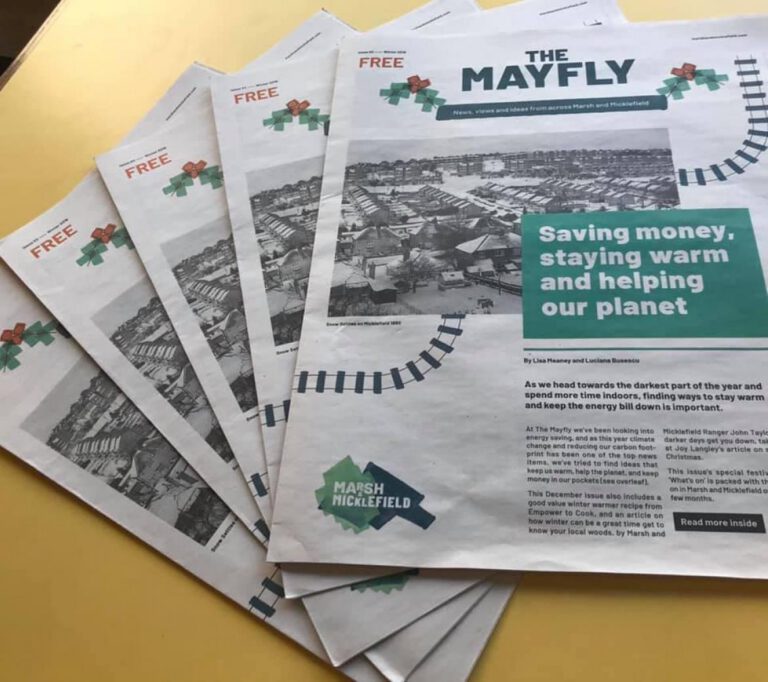
Midway through the programme Marsh and Micklefield Big Local launched its own free, community newspaper – Mayfly – to keep residents informed of partnership and community news and events. The large-format, full-colour, printed publication included profiles of local people, articles by a local therapist and a woodlands ranger, recipes, pictures for colouring, puzzles, and competitions.
Partnership members brainstormed ideas for each issue and articles were actively sourced from both neighbourhoods. During the Covid-19 pandemic, the partnership adapted to produce a digital fortnightly mini-edition, which could be printed at home. With legacy in mind, they later developed a website where community members could easily contribute news and stories. The partnership hoped that this online format would enable Mayfly to continue beyond Big Local.
Investing in young people
Supporting learning and play beyond the classroom
The partnership wanted to collaborate with schools in the Marsh and Micklefield Big Local area, but initially found it difficult to build successful connections. However, mid-way through Big Local, a partnership member delivered an assembly about caring for the local area, which led to a lasting relationship with Ash Hill Primary School in Micklefield.
Towards the end of the programme, Big Local funding was used for 15 laptops for Ash Hill Primary School’s ‘nurture nest’ (a space encouraging positive choices through daily check-ins and rewards) and for a theatre group to perform a pantomime. Pupils were highly engaged throughout the pantomime, all staying for the full performance.
When Ash Hill Primary School were unable to renovate their courtyard garden, Big Local funding was provided alongside organisational support from the partnership. The finished garden provided a valuable outdoor learning space (used for Grow Together sessions run by the community allotment) and staff felt it played an important role in pupils’ emotional regulation.
The partnership also worked with Marsh Infant and Nursery School towards the end of Big Local, with funding allocated to create a den where pupils could enjoy books and quiet activities outside the classroom. Designed in consultation with children, the cosy space was furnished with a rug, cushions, and books.
Health and wellbeing
Boosting health, self-discipline, and confidence through kickboxing
The partnership’s small community-chest grants often established relationships that led to greater investment in local groups. For example, towards the end of the programme, Marsh and Micklefield Big Local awarded a £500 grant to a local, volunteer-run kickboxing club. Catering for ages 5 to adult, the club aimed to build confidence, instil self-discipline, and relieve stress.
Later the same year, when the club could not afford to attend the National Championships, a further grant of £6,125 funded transport, entry fees, and competition-approved equipment. This funding enabled 19 students to participate, returning with pride and eight National Championship medals.
Improving wellbeing through a community allotment
Grow Together Bucks was a community allotment set up during a Covid-19 pandemic lockdown. After they attended a community fair in Wrights Meadow Centre in 2024, partnership members visited their site and encouraged them to apply for a small grant. This funding helped Grow Together Bucks buy a solar-powered greenhouse watering system, so volunteers didn’t need to be on site every day. Further grants, for a storage shed and a second greenhouse, meant the group could grow more plants for the local schools they worked with, while enabling members growing their own produce to access spades, forks, and trowels.
The allotment became a thriving, organic growing space, with around 25 regular volunteers who cooked a monthly communal meal on site using their own produce. Each week, any excess produce was donated to the local food bank – from cabbage and carrots, to coriander and kohl rabi. Allotment volunteers (including those with mental or physical health issues) benefited from working with a purpose and connecting with others in a peaceful, friendly environment.
How the Big Local area spent their funding
Each Big Local area received approximately £1.2 million (ranging from £1.199 mil to 1.209 mil) to spend over 10–15 years, depending on how much additional funding they accessed from Local Trust to address specific needs. For example, to bring people together at the start of the programme or to access training and support. This has been categorised for areas and at the programme level based on reports received from areas.
Partnerships chose their own priorities and categories for reporting, and were encouraged to use broad categories so they could use the funding flexibly. All areas spent a significant amount of money on ‘Big Local delivery costs’ such as workers’ salaries, stationery and IT equipment. You can find out more about programme level spend in this article. This is how Marsh and Micklefield Big Local told Local Trust they used their Big Local funding.
References
Department for Environment, Food & Rural Affairs (DEFRA) (2025) ‘Access to Green Space in England’. (Accessed 5 December 2025)
Friends of the Earth (2023) ‘Tree cover by English neighbourhoods’. (Accessed 4 December 2025)
Ministry of Housing, Communities & Local Government (MHCLG) (2019) ‘English indices of deprivation 2019’. (Accessed 4 December 2025)
Office for National Statistics (ONS) (2022) ‘UK Census 2021: All persons’. (Accessed 4 December 2025)
Office for National Statistics (ONS) (2023a) ‘UK Census 2021: Ethnic group: Asian, Asian British or Asian Welsh’. (Accessed 4 December 2025)
Office for National Statistics (ONS) (2023b) ‘UK Census 2021: Ethnic group: Black, Black British, Black Welsh, Caribbean or African’. (Accessed 4 December 2025)