North East Hastings
Key points
- Supporting community spaces (including the Hastings and St Leonard’s Men’s Shed and the Ore Community Library) catalysed change across the community and built local capacity.
- Speckled Wood was protected to remain a community resource through the purchase of adjacent pockets of land via the Ore Community Land Trust.
- A small grants scheme was implemented to support a wide range of community projects – including football training for young people and providing tablets for older people during the Covid-19 pandemic.
About the Big Local area
The North East Hastings Big Local area covered parts of three electoral wards in East Sussex: Baird, Ore and Tressell. The hills and valleys of north-east Hastings acted as natural barriers that made moving between neighbourhoods difficult without a car. This meant that residents tended to identify with separate individual communities, including the Broomgrove, Downs Farm, Halton and Red Lake estates. Though the area was only a couple of miles from Hastings town centre, many residents felt isolated or separated from it.
The predominantly White British population of 8,800 lived mostly in terraced housing or purpose-built flats (ONS, 2022; 2023a). There was a higher percentage of lone-parent families with dependent children than the average for the South East (ONS, 2024), with 30 per cent of children under the age of 19 living in low-income families (DWP, 2024a). Compared with the wider South East, home and car ownership were lower (ONS 2023b, 2023c), while unemployment and social isolation were higher (DWP 2024b; 2024c; OCSI, 2019). Some areas, like Broomgrove, were among the 10 per cent most deprived areas in England (MHCLG, 2019).
How the Big Local area approached delivery
The North East Hastings Big Local partnership was established in 2014. Early consultations with the community identified improving community facilities and providing opportunities for families as key priorities.
Initially, the partnership developed subgroups. This structure was later simplified to one main group to reflect participation levels. Many partnership members were also involved in other local voluntary activities and organisations. The partnership sometimes found it challenging to maintain enough resident members to meet Local Trust’s criteria, but there was a committed core group of residents involved for the entire programme.
At an early stage, partnership members realised there was a need for paid staff to support delivery. Big Local funding was used to employ a part-time community development worker and a part-time administrator. Taking an asset-based approach, the partnership decided to work with existing partners delivering in the community, or those who could bring new opportunities to the area. When required, the partnership called on local experts, such as a council officer, who provided advice when the partnership commissioned play services. The partnership also benefited from the support of their Locally Trusted Organisation (LTO) – Hastings Voluntary Action (HVA). In post for most of the programme, HVA provided insight into community needs and connected the partnership with key local stakeholders.
The partnership identified value among existing community spaces and groups. Big Local funding was strategically invested in four community centres, an adventure playground, and a Men’s Shed. The partnership was proud to support the addition of the Ore Community Library to this list through early grants. Alongside this, the partnership prioritised tailored support to meet residents’ specific needs. For example, food packages for residents experiencing food poverty, which were adapted to their circumstances. For example, providing microwaveable food to households without an oven.
An important part of the partnership’s legacy came from directly supporting existing community infrastructure and helping them apply for funding that maintained and built on their work. This included being part of the panel allocating £200,000 from the UK Shared Prosperity Fund. The funding enabled support and improvements in the Broomgrove area, including the Broomgrove Community Centre (run by Oasis Community Project East Hastings) and the Adventure Playground (run by In2Play).
As the programme came to an end, Big Local funding was used for a celebration event at the Ore Community Centre. Alongside stilt walkers and an interactive snow globe, the partnership worked with some of their key stakeholders (such as Ore Community Library and Ore Community Land Trust) to develop an exhibition showcasing their collective achievements over the previous decade.
A Big Local partnership was a group made up of at least eight people that guided the overall direction of delivery in a Big Local area.
A locally trusted organisation (LTO) was the organisation chosen by people in a Big Local area or the partnership to administer and account for funding, and/or deliver activities or services on behalf of a partnership. Areas might have worked with more than one locally trusted organisation depending on the plan and the skills and resources required.
What the Big Local area did
Community assets and spaces
Investing strategically in community infrastructure
The Big Local partnership was keen to be an active supporter of existing community assets in the North East Hastings area. The flexibility of Big Local funding enabled investment in costs that could have been challenging for fundraising in small organisations. For example, a pizza oven for the In2Play Adventure Playground (so children attending after-school activities could get involved in cooking sessions), and staff costs for Ore Community Centre (enabling more room hire bookings).
Big Local funding was often the starting point for community spaces to secure their long-term future in the area. Hastings and St Leonard’s Men’s Shed accessed several grants from the partnership for equipment and storage, helping the group to grow – as Big Local came to an end, their membership was around 200 people. The group had also been successful in securing ownership of their previously rented building, and were in the process of fundraising for a new roof.
In another example, long-term Big Local funding was provided for community activities and trips through the Oasis Community Project East Hastings – a local charity aimed at bringing residents together. When the Broomgrove Community Centre needed new management, Oasis was able to evidence their role in successfully supporting residents and were granted a 25-year lease to operate the centre. In one of the partnership’s final rounds of grants, the newly named Oasis Broomgrove Hub received funding for building improvements. The hub went on to add new kitchen facilities, which boosted their offer to residents through Stay and Play sessions, lunch clubs, and a social supermarket.
Providing match funding to protect a community library
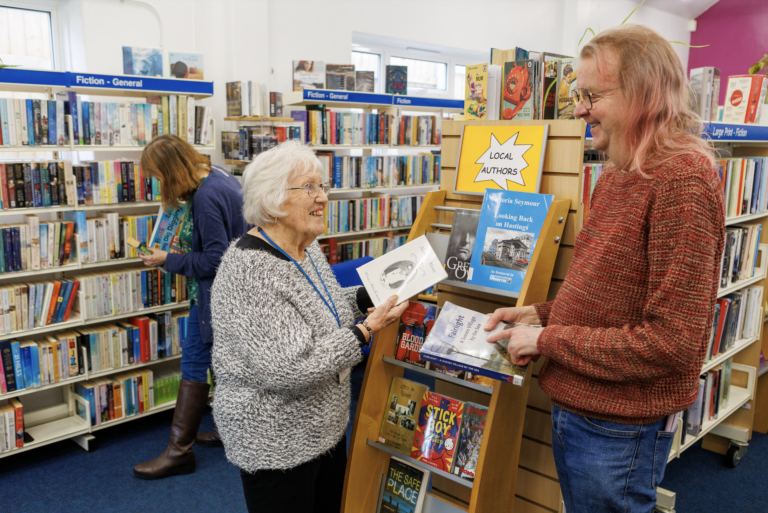
When the council-run library in Ore closed in 2018, partnership members became involved in the community’s efforts to re-open it. Through this campaign, the council granted management of the library to a new volunteer-led charity on a three-year, low-cost lease, which was later extended to a 20-year lease following the library’s success. Big Local match-funding enabled the charity to access grants from the local housing association, and the Ore Community Library opened in 2021. Subsequent grants from the partnership contributed to set up costs like IT equipment and signage.
Supported by over 20 volunteers, the library became an important resource for the community. It hosted a range of services including a book club and story time sessions for children under five. IT facilities provided essential support for residents applying for jobs, Universal Credit, or other benefits, while Big Local funding was used for Hastings Advice and Representation Centre to deliver a weekly benefits advice surgery.
The library soon had 1,000 members, over half of whom were under the age of sixteen. As the Big Local programme came to an end, the Ore Community Library Group was planning to make structural improvements to the building to ensure it could remain a valuable community resource into the future.
Securing green space for community use
As with the Ore Community Library, the North East Hastings Big Local partnership took a similar approach to secure a 5.1 hectare woodland and park for community use. Speckled Wood was often under threat from development. Big Local funding was used to purchase several separate, small plots of land surrounding the site, which would make development difficult. Alongside the woodland itself, this also included a community garden and Ore village green. The success of this initiative came from working in partnership with Ore Community Land Trust – a local, resident-led organisation committed to preserving urban woodland for community use and protecting animal habitats.
Ore Community Land Trust went on to access additional Big Local funding to run Forest School sessions in Speckled Wood for local children and families. These sessions provided opportunities for hands-on outdoor experiences, supporting children to develop a curiosity for biodiversity and the natural world.
Volunteers played a key role in the conservation of Speckled Wood. Those involved reported that it helped give them a sense of purpose, build their confidence, and feel less isolated. One partnership member reflected on the benefits of being outside with others, and felt it was beneficial for volunteers’ mental health. As the Big Local programme came to an end, the Ore Community Land Trust continued to grow their volunteer base and ran their first Summer Fete for residents on Ore Village Green.
Community engagement
Using small grants to support new ideas and existing groups
The North East Hastings Big Local partnership had a small grants scheme which offered grants of up to £1,066 – a figure selected to reflect local history (1066 being the year of the Battle of Hastings). The aim of the grant scheme was to allow the partnership to be responsive to new ideas or emerging challenges in the community. As such, the partnership avoided specifying funding themes, wanting to respond to community needs identified by grant applicants.
The application form was kept simple, and for many groups who received a small grant this was their first experience of working with a funder. The partnership’s Community Development Worker built relationships with applicants and advised them on how to improve their applications and develop their projects. Through this the groups developed confidence and experience to successfully apply for grants from other funders.
In the case of the Hastings and St Leonard’s Men’s Shed, Big Local funding was used to broaden access to the project. Small grants were provided for equipment on the condition of introducing diversity policies and training volunteers to better support residents with a range of needs. As a result, women, younger people, disabled people, and people with dementia became involved in activities and membership grew steadily over the course of the Big Local programme.
The partnership used their small grants scheme to support residents during the Covid-19 pandemic. For example, a group of older people received a tablet, dongle, and training in how to use them, so they could access the internet. This was particularly useful to reduce social isolation. Families were also supported with digital inclusion, with a grant used to provide tablets so children could continue their schoolwork online.
Towards the end of Big Local the partnership reflected that projects supported through their small grants – like the Hastings Storytelling Festival and Hastings and St Leonard’s Men’s Shed – were some of their proudest achievements. They felt the simplicity of the application process meant grant-recipients had been able to have high impact with minimal up-front effort. Over the whole Big Local programme, at least £150,000 was awarded to over 170 projects in the area.
Investing in young people
Supporting children and families to broaden their experiences
Over the course of the programme, Big Local funding was provided for a range of activities for young people in the North East Hastings community. This included grants that helped the community access activities that had not previously been available, such as Brighton & Hove Albion Football Club’s ‘Premier League Kicks’ football training sessions. Another example was Hastings Storytelling Festival, which had not run activities in the area before and delivered performances in local schools thanks to Big Local grant funding.
The partnership also commissioned after-school activities for children living in isolated communities on the Broomgrove and Downs Farm estates. This initiative, delivered by In2Play, created new opportunities for children, young people and families to socialise and travel out of the area. To remove financial barriers, these activities were offered at no charge to residents and provided children with free refreshments.
To build trust with children and families, the partnership took a long-term approach. Funding was provided for four years and expanded to include activities during school holidays. The programme became well-established in both estates and In2Play was able to play an important role in the partnership’s response to the Covid-19 pandemic, distributing food and activity packs to local families. In2Play went on to be awarded £270,000 of National Lottery Community funding so the initiative could continue beyond the Big Local programme.
How the Big Local area spent their funding
Each Big Local area received approximately £1.2 million (ranging from £1.199 mil to 1.209 mil) to spend over 10–15 years, depending on how much additional funding they accessed from Local Trust to address specific needs. For example, to bring people together at the start of the programme or to access training and support. This has been categorised for areas and at the programme level based on reports received from areas.
Partnerships chose their own priorities and categories for reporting, and were encouraged to use broad categories so they could use the funding flexibly. All areas spent a significant amount of money on ‘Big Local delivery costs’ such as workers’ salaries, stationery and IT equipment. You can find out more about programme level spend in this article. This is how North East Hastings Big Local told Local Trust they used their Big Local funding.
References
Department for Work and Pensions (DWP) (2024a) ‘Children in low income families: local area statistics’. Available at: gov.uk/government/statistics/children-in-low-income-families-local-area-statistics-2014-to-2023/children-in-low-income-families-local-area-statistics-financial-year-ending-2023 (Accessed 28 November 2024)
Department for Work and Pensions (DWP) (2024b) ‘People on universal credit: not in employment’. Available at: gov.uk/government/statistics/dwp-benefits-statistics-november-2024 (Accessed 24 January 2025)
Department for Work and Pensions (DWP) (2024c) ‘Jobseekers allowance’. Available at: gov.uk/government/statistics/dwp-benefits-statistics-november-2024 (Accessed 24 January 2025)
Ministry of Housing, Communities & Local Government (MHCLG) (2019) ‘English indices of deprivation 2019’. Available at: gov.uk/government/statistics/english-indices-of-deprivation-2019 (Accessed 28 November 2024)
Office for National Statistics (ONS) (2022) ‘UK Census 2021: All persons’. Available at: ons.gov.uk/peoplepopulationandcommunity/populationandmigration/populationestimates/datasets/populationandhouseholdestimatesenglandandwalescensus2021 (Accessed 28 November 2024)
Office for National Statistics (ONS) (2023a) ‘UK Census 2021: Ethnic group: White: English, Welsh, Scottish, Northern Irish or British’. Available at: ons.gov.uk/datasets/TS021/editions/2021/versions/3
(Accessed 28 November 2024)
Office for National Statistics (ONS) (2023b) ‘UK Census 2021: No cars or vans in household’. Available at: ons.gov.uk/datasets/TS045/editions/2021/versions/4 (Accessed 28 November 2024)
Office for National Statistics (ONS) (2023c) ‘UK Census 2021: Social rented housing’. Available at: ons.gov.uk/peoplepopulationandcommunity/housing/bulletins/housingenglandandwales/census2021 (Accessed 28 November 2024)
Office for National Statistics (ONS) (2024) ‘UK Census 2021: Families and households: Lone parent households with dependent children’. Available at: ons.gov.uk/peoplepopulationandcommunity/birthsdeathsandmarriages/families/datasets/familiesandhouseholdsfamiliesandhouseholds/current (Accessed 28 November 2024)
Oxford Consultants for Social Inclusion (OCSI) (2019) ‘Left behind neighbourhoods’. Available at: ocsi.uk/left-behind-neighbourhoods/ (Accessed 24 January 2025)