Selby Town
Key points
- A disused shop was transformed into a community hub, creating a welcoming space for residents to meet, access support, and take part in a wide range of activities.
- New places and opportunities were opened to help raise aspirations among young people, particularly supporting the transition from primary to secondary school through skills-building, trips to local venues, and career events.
- Community health and wellbeing was supported through collaborative projects focused on food and access to health and wellbeing information, helping to address financial barriers to accessing support.
About the Big Local area
The Selby Big Local area included two residential estates (Flaxley Road to the north and Abbots Road to the south), joined by a town centre which attracted residents from surrounding areas. Most residents that spoke to the Big Local partnership saw the estates as nice places to live, with good outside space (including parks, green spaces, play areas, and walks and cycle routes along the River Ouse).
In 2021, the total population of the Selby Big Local area was 9,887 (ONS, 2022). Compared to the wider Yorkshire and Humber region, the area showed lower level of educational attainment in the general population (2023a), and higher levels of unemployment among young people (DWP, 2025a; 2025b). Manufacturing and industry (such as farming, ship-building, coalmining and flour milling) in this small market town had declined, and residents travelled to adjacent cities like Leeds, York, and Hull for work. Compared to Yorkshire and Humber, there were also slightly higher levels of disabled people or those living with health conditions that limit their day to day activities (ONS, 2023b; 2023c).
How the Big Local area approached delivery
The Selby Big Local partnership was mainly made up of residents and local councillors, with a representative from the Locally Trusted Organisation (LTO) – Up for Yorkshire (the working name of Selby District Association of Voluntary Service). Initially, some local organisations joined the partnership for short periods. The partnership felt that the local council increasingly recognised the challenges and inequalities facing Selby residents, because of their involvement in Big Local.
The Covid-19 pandemic had a slowing effect on Selby Big Local, and this saw the partnership shrink from its peak of 15 members in 2019 to a smaller group in 2022. While the partnership successfully attracted new volunteers (such as people who had recently moved to the area), it was hard to keep them involved long-term, as people’s commitments outside the partnership changed.
In the first five years, the partnership engaged workers to support relationship-building; this was followed by a period with no worker, coinciding with the drop in activity around the Covid-19 pandemic. Towards the end of the Big Local programme, another worker was engaged to support the partnership in building its legacy.
The partnership had four priorities: Community involvement and participation, Health and wellbeing, Opportunities for young people, Employment, and Skills and training. The partnership pursued these priorities primarily through small grants schemes from 2016 to 2019, culminating in the purchase of a property that would become its hub in 2019. The partnership’s legacy organisation, Our Space CIO, was registered in 2023, to manage the community hub (which opened in December 2024) and continue the partnership’s vision of making Selby an even better place to live.
A locally trusted organisation (LTO) was the organisation chosen by people in a Big Local area or the partnership to administer and account for funding, and/or deliver activities or services on behalf of a partnership. Areas might have worked with more than one locally trusted organisation depending on the plan and the skills and resources required.
What the Big Local area did
Community assets and spaces
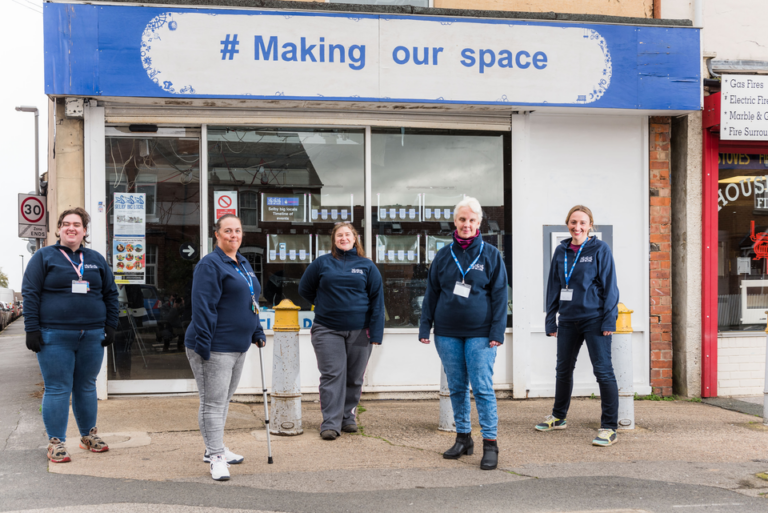
Transforming a disused shop into a community hub
Early on, through survey and door-to-door consultation, the partnership identified the north of the Big Local area as being under-resourced. Although community space and activities existed in the adjacent central and southern parts of Selby, the partnership reflected that residents struggled to travel across the area to reach them.
The aim was to create a community-owned space in north Selby that could operate flexibly so residents could drop-in, and activities could be held at any time. Through community engagement and research, the partnership identified a link between loneliness and social isolation, and a lack of spaces where residents felt welcome.
Mid-way through the programme, in 2019, Big Local funding was used to purchase a disused shop. Planning permission was secured the following year and the partnership and Locally Trusted Organisation (LTO) worked with architects and consultants to refurbish the property. Towards the end of Big Local, in 2024, the building was handed over to the LTO (and ultimately Selby Big Local’s legacy organisation – Our Space CIC) as ready-to-open, albeit with some works outstanding (including making the building accessible).
The partnership identified some challenges and learning from the experience of taking on the Our Space building. For example, it was difficult to keep residents interested in what would be possible once the hub opened, due to the long period of building and the effort that the works required. So, during construction the partnership continued engaging the community, through its #makingourspace building design activities and an artwork competition, so the community could weigh in on the design of the space.
New opportunities to connect with local projects and services emerged, with the partnership noting a general increase in community activity in north Selby between purchasing and opening the building. Informal feedback from residents who attended the launch of Our Space suggested that it was set to become an inclusive and welcoming community space.
Our Space grew steadily to become a well-used and valued community hub offering a regular programme of activities throughout the week. These included a weekly parent drop-in led by an early years worker, the New Hope Club for people with learning differences, disabilities, and neurodiversity (alongside their carers and support workers), and youth sessions known as ZONE, which included a leadership scheme for young people.
Residents could also participate in creative and social activities such as a weekly knit and natter, drawing sessions, and a board games club, as well as a community tearoom open five days a week. In addition to this regular offer, the hub hosted one-off sessions and short courses on more specialist topics, such as sign language and introductory animation. The partnership felt these activities created a lively, positive, and safe space for residents of different ages and with different needs to access support and build a sense of community and belonging.
Community engagement
Using community grants to build interest in Big Local
The partnership’s aim in their Big Local plan was to make Selby an even better place to live. Its priorities were to tackle social isolation, improve health and wellbeing, and create new opportunities for change.
These priorities were initially pursued through small grants programmes. Early on, in 2016, You Choose used a participatory budgeting approach to give residents a choice on where to direct £3,000 in funding. A second round was held in 2017 with a larger pot of £10,000, accepting applications up to £5,000.
One of the grants supported a community choir, which began meeting at a local church twice a month and went on to become a constituted group. The partnership described the choir as a popular and vibrant presence in the community, with concerts at local events (including Christmas) and places (like the care home).
After a review of its small grants programmes in 2017, the Selby Big Local partnership launched its Community Chest. This ran from 2018 to 2020, offering up to £500 to individuals and £2,000 to community groups. These grants provided support for Sleepsafe Selby (among others) – a local charity providing accommodation for people experiencing homelessness – who used their grants to pay for running costs and utilities.
Small grants schemes gave the partnership a chance to learn about participatory grant-making; experiment with different amounts of funding; and test ways to encourage people to apply.
A Big Local Plan set out what changes the partnership planned to make, how they planned to deliver on this and how funds were to be allocated. It was written for themselves, their community and Local Trust, as a guide and action plan.
Investing in young people
Raising aspirations for education and work
The Selby partnership’s community consultation identified low aspirations among young people as a priority need in their community. As such, they wanted to support young people to improve life chances and to achieve their ambitions.
The Big Aspirations programme sought to address this priority need. It was a joint programme between Selby Big Local, North Yorkshire Business and Education Partnership (NYBEP), and three primary schools. Over two years, the programme worked with 120 Year 6 pupils. It aimed to inspire young people about the world of work, raise aspirations, and develop skills to support future choices and the transition to secondary school.
The programme included visits to a regional theatre, college, and careers events; and taking part in educational workshops, and enterprise, team building and leadership activities. Feedback from the primary schools about the impact of the programme was positive. Teachers reported that pupils had more confidence and clarity about what their futures might look like and how to get there. The activities helped foster reflection, teamwork, communication, and leadership skills.
The partnership further reflected that it may have benefitted pupils if the support had continued beyond primary school, to further aid their transition between schools and continue encouraging them to aspire and learn.
Health and wellbeing
Supporting resident wellbeing by working collaboratively
The partnership wanted people of all ages living in Selby to feel emotionally and physically well, with happy, healthy, and fulfilling lives. They identified health and wellbeing, particularly social isolation, as a priority and found that this was affecting both younger and older residents.
From community consultations, the partnership identified a link between wellbeing and financial issues (such as being in low-paid work, unemployed, or having debts), in part because financial issues can lead to a poor quality diet. Considering this, alongside other local wellbeing issues, the partnership wanted their work to address both food poverty and social isolation. In 2018, the partnership held an event for local people and providers to come together and look at opportunities for developing new projects to build on the community’s strengths and assets.
The Selby Community Fridge launched in January 2021 to address food poverty and food waste. Open three afternoons a week, it was part of a wider community fridge network that collected from supermarkets, smaller food business, and individual donations. Linked to this was a community cookery project (focused on cooking as a family, cooking on a budget, and mindful eating) and a Tea and Toast project, where people came together over food. These initiatives helped combat social isolation and improve access for attendees, who may have otherwise been less connected to health services and community activities.
Projects were delivered collaboratively with Up for Yorkshire (the Locally Trusted Organisation), a food bank, the local council, a church, Groundwork, and Selby Health Matters (a strategic group of local authority, health, and voluntary and community sector representatives). This way of working helped build successful relationships between stakeholders and leverage additional funding to support the community.
After opening Our Space (their community hub) in 2024, the partnership engaged health workers, social prescribers, and a mental health charity to deliver outreach and services from the hub. They saw Our Space as a key way to continue supporting residents’ health and wellbeing. For example, a ‘self-care week’ brought together local organisations and health providers to offer free drop-in sessions, including blood pressure checks from Active North Yorkshire, and advice on nutrition, stopping smoking, and managing muscular pain. Recognising the links between financial issues and wellbeing, these sessions meant residents could access free health support in a relaxed and familiar environment.
How the Big Local area spent their funding
Each Big Local area received approximately £1.2 million (ranging from £1.199 mil to 1.209 mil) to spend over 10–15 years, depending on how much additional funding they accessed from Local Trust to address specific needs. For example, to bring people together at the start of the programme or to access training and support. This has been categorised for areas and at the programme level based on reports received from areas.
Partnerships chose their own priorities and categories for reporting, and were encouraged to use broad categories so they could use the funding flexibly. All areas spent a significant amount of money on‘Big Local delivery costs’ such as workers’ salaries, stationery and IT equipment. You can find out more about programme level spend in this article. This is how Selby Town Big Local told Local Trust they used their Big Local funding.
References
Department for Work and Pensions (DWP) (2025a) ‘Universal credit: Employment status by age’. Available at: gov.uk/government/statistics/dwp-benefits-statistics-august-2025 (Accessed 8 October 2025)
Department for Work and Pensions (DWP) (2025b) ‘Jobseekers allowance by age’. Available at: gov.uk/government/statistics/dwp-benefits-statistics-august-2025 (Accessed 8 October 2025)
Office for National Statistics (ONS) (2022) ‘UK Census 2021: All persons’. Available at: ons.gov.uk/peoplepopulationandcommunity/populationandmigration/populationestimates/datasets/populationandhouseholdestimatesenglandandwalescensus2021 (Accessed 8 October 2025)
Office for National Statistics (ONS) (2023a) ‘UK Census 2021: Highest level of qualification: No qualifications’. Available at: ons.gov.uk/datasets/TS067/editions/2021/versions/3 (Accessed 8 October 2025)
Office for National Statistics (ONS) (2023b) ‘UK Census 2021: 1 or more person disabled under the Equality Act in household’. Available at: ons.gov.uk/peoplepopulationandcommunity/healthandsocialcare/healthandwellbeing/bulletins/disabilityenglandandwales/census2021#the-number-of-households-where-at-least-one-person-was-identified-as-disabled/ (Accessed 8 October 2025)
Office for National Statistics (ONS) (2023c) ‘UK Census 2021: Disabled under the Equality Act: Day-to-day activities limited a lot’. Available at: ons.gov.uk/datasets/TS038/editions/2021/versions/3 (Accessed 8 October 2025)