Whitley Bay
Key points
- A masterplan was created for the town, which improved the look of the seafront and influenced the council’s regeneration plan for Whitley Bay.
- An old Job Centre was transformed into a community eco-hub – a carbon neutral and financially sustainable community space.
- Volunteer-led activity was supported through Small Sparks community grants and the revival of Whitley Bay carnival.
About the Big Local area
The Whitley Bay Big Local area covered part of a seaside town in the North East that was inhabited by 2,861 people (ONS, 2022). Once a popular holiday destination for people from the North East and Scotland, at the start of Big Local residents reflected that the town was getting fewer holiday visitors and noted the closure of historic leisure facilities. As the Big Local programme progressed, council investment in the regeneration of the seafront saw the reopening of an iconic building; a thriving town centre with independent shops, cafes and cinema; and an increasing range of community activities.
The area had good transport links, serviced by Whitley Bay Metro Station. Almost half the homes in the area were flats, compared to 14 per cent in the North East, and 32 per cent of residents were living in privately rented accommodation (compared to 15 per cent in the North East) (ONS , 2023a; 2023b; 2023c; 2023d). Levels of reported anti-social behaviour were almost three times the England average (Police UK, 2025), and there were several disused properties in a state of disrepair around the seafront. However, partnership members noted a strong sense of community in Whitley Bay, and the area’s natural coastline as one of its best-loved assets.
A Big Local partnership was a group made up of at least eight people that guided the overall direction of delivery in a Big Local area.
How the Big Local area approached delivery
At the start of programme, the partnership commissioned a consultancy to undertake community consultation and develop a detailed profile of the area. These helped to create the Whitley Bay Big Local vision – “to create a strong, happy, creative community and surroundings that look cared for so residents and visitors can access the support we need to thrive”. To achieve this, the partnership set out three priorities, which remained broadly the same over the course of the programme. The priorities focused on people, including supporting community activity, developing skills, and business support; the environment, such as a cleaner and greener town centre and seafront; and wellbeing, including work with people in vulnerable circumstances. As time went on, additional priorities around engagement, partnerships and infrastructure (including a new building) were added.
Consultation activities revealed a strong sense of pride and warmth towards Whitley Bay, from local residents and communities across the wider Tyneside area. The partnership felt they had a unique opportunity to reclaim the area, improve the aesthetics and accessibility of their much-loved seafront, and develop local facilities and attractions.
The Whitley Bay Big Local partnership created a structure comprising 12 voting places: eight for residents and four for others interested in the work of Big Local, as well as two non-voting places for a local councillor and the Locally Trusted Organisation (LTO). Plans were delivered by partnership members and volunteers with the support of paid workers, alongside partnerships and commissions with external organisations. The Big Local partnership set up ‘theme groups’, bringing residents together around each of Whitley Bay Big Local priorities. In addition, a community forum provided an opportunity for residents and other stakeholders to meet at least twice a year and contribute ideas for achieving the Big Local vision and outcomes.
These structures remained in place – with slight amendments — until midway through the programme, when Whitley Bay Big Local registered as a Charitable Incorporated Organisation (CIO). In practice, there was little change; the members of the Big Local partnership were also the trustees of the CIO, and the theme groups remained, though the community forum was replaced with a more diverse range of consultation activities. Over time, the creation of the CIO enabled the Whitley Bay Big Local partnership to employ staff, own a building, and manage its own finances and funding development, and created a legacy of activity in the community that could last into the future.
A locally trusted organisation (LTO) was the organisation chosen by people in a Big Local area or the partnership to administer and account for funding, and/or deliver activities or services on behalf of a partnership. Areas might have worked with more than one locally trusted organisation depending on the plan and the skills and resources required.
Many Big Local partnerships funded workers to support the delivery of Big Local. They were paid individuals, as opposed to those who volunteered their time. They were different from Big Local reps and advisors, who were appointed and paid by Local Trust.
What the Big Local area did
Working collaboratively
Building relationships to influence long-term plans for the area
While the Big Local programme was running, the North Tyneside Council were developing a multi-million-pound investment plan for Whitley Bay seafront. Partnership members were keen to influence this regeneration and ensure that residents’ voices were incorporated into plans.
In the early years of Big Local, the partnership commissioned a local landscape architect to develop Whitley Bay Big Local’s ‘masterplan’, and consulted with residents on what the regeneration should focus on. The masterplan became a blueprint for Big Local activities, and a means of kickstarting relationships that would have a long-lasting impact in the area. The partnership used this to facilitate conversations and develop relationships with strategic agencies, and the council took copies of the masterplan to look at how it could be embedded in their own work. This helped inform ongoing maintenance (including the makeover of shopfronts, lampposts, signage, seating and planters) and supported a return to Whitley Bay’s traditional blue colour palette.
As a result, a councillor noted that the relationship with the partnership helped elected members and officers think about things differently and incorporate some of the Big Local plans into the council’s development plan. The partnership felt they had helped create a bridge between resident voices and activities, and the council’s decision-making. For example, Friends of Whitley Park (a group supported by Big Local funding) was able to get the park included in the seafront regeneration plan as a local attraction.
A Big Local Plan set out what changes the partnership planned to make, how they planned to deliver on this and how funds were to be allocated. It was written for themselves, their community and Local Trust, as a guide and action plan.
Community assets and spaces
Developing a community eco-hub
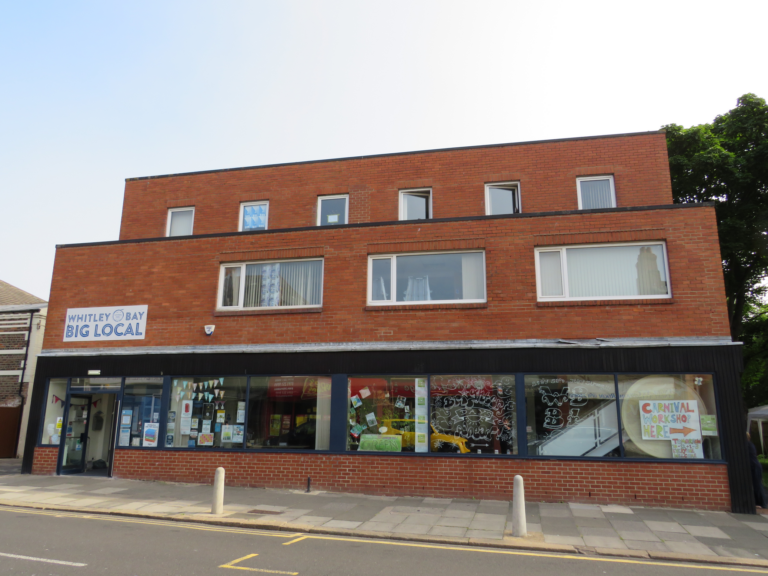
The Whitley Bay partnership operated from community shop space from the beginning of the programme. However, they were looking for a more permanent base in the community. After several years of renting shop fronts, they purchased a three-storey building (previously used as a Job Centre) with the intention of converting it into a community eco-hub.
The partnership held open days to understand how residents wanted to use the space and gave these findings to an architect who sketched out a design for the space. The criteria for the hub included: community benefit, financial sustainability, environmental sustainability, and flexibility of use. In addition to Big Local funding, funding was provided by partners including the local authority and the government Department for Levelling Up.
The hub was designed to support carbon neutrality, with the old roof replaced with a recyclable UPVC surface and fitted with solar panels. The ground floor and attached community garden were completely refurbished to feature a kitchen and café, and to support disabled access into and around the building. The first and second floors had bookable meeting rooms, activity rooms, and co-working facilities. This provided a means of generating income so that the hub could become financially sustainable.
The Mayor for North Tyneside attended the opening of the hub in 2023, which became a welcoming, flexible, community-focused space. The partnership described it as a ‘launch pad’, owing to the bookable spaces that provided a blank canvas for local people to bring their ideas to life. It also provided opportunities for more Big Local activities across all three of the partnership’s priorities. Weekly activities at the hub included debt and money advice, an energy saving eco shop, a pay as you go pantry, craft groups, yoga, sign language classes, and a repairs café.
Towards the end of the Big Local programme, this continued to be a thriving community space that ran a busy timetable of activities, six days a week.
Improving the local seafront and wider environment
Big Local funding was used to create the role of a neighbourhood caretaker. Assisted by a group of volunteers, the ‘Tidy Town’ worker complemented council services and the Big Local masterplan by improving the look of the area.
The worker carried out maintenance tasks including graffiti removal, improved building frontages, painting, and taking care of the town’s green spaces. As the caretaker carried out work around the town, they also regularly chatted with residents to find out what other tasks they wanted done. For example, residents identified an empty pub building along the seafront which they described as an ‘eyesore’. With the help of volunteers, the Tidy Town worker spent a day clearing the weeds and rubbish that had accumulated and tidied up the front of the building. The partnership reflected that investing in these maintenance activities had a knock-on effect, encouraging more residents to take ownership and care over communal spaces in Whitley Bay.
Community engagement
Funding residents’ ideas
Small Sparks was a small-scale light-touch grants programme that ran throughout the lifetime of Whitley Bay Big Local, allowing residents to try new ideas, get activities running, and test demand. Grants of up to £250 were given to individuals and groups for diverse activities such as jewellery making and a choir. Applicants simply needed to demonstrate that their project helped meet one of the Whitley Bay Big Local plan objectives.
This supported many local projects. For example, the Green Beans Market, a monthly market at Whitley Bay Metro Station that featured art exhibitions, live music, food and drink stalls, and stands selling local produce and upcycled crafts. The Friends of Whitley Bay volunteer group also received funding for bulb planting and to install bat boxes at the local park.
The partnership felt that Small Sparks got to the heart of what Big Local was about – helping local people become actively involved in addressing issues that they themselves identified. They reflected that the success of the project came from an ethos of all being in it together, and that it built on people’s talents, passions and strengths by ‘enabling all the attributes in the community to shine out’. Individual Small Sparks grants provided the building blocks for community connections and further collective projects.
Place-based pride and connection
Creating a financially sustainable annual carnival
After community consultation revealed that residents wanted to see the revival of a local carnival in Whitley Bay, this became one of the partnership’s first activities. This was run by Big Local in its first year, where it began as a small carnival parade and afternoon of live music. The first event was attended by over 2,000 people.
Whitley Bay Carnival became an annual event (including a ‘lockdown carnival’ in 2020), and prompted the creation of a not-for-profit arts company, Salto Arts Production, with annual Big Local funding. This enabled the carnival to generate its own momentum and future, without being dependent on Big Local funding. It was described by one organiser as a catalyst for people to engage in the community through costume making and fringe activities, as well as on the day of the parade. An estimated 1,000 people contributed to the 2018 event.
How the Big Local area spent their funding
Each Big Local area received approximately £1.2 million (ranging from £1.199 mil to 1.209 mil) to spend over 10–15 years, depending on how much additional funding they accessed from Local Trust to address specific needs. For example, to bring people together at the start of the programme or to access training and support. This has been categorised for areas and at the programme level based on reports received from areas.
Partnerships chose their own priorities and categories for reporting, and were encouraged to use broad categories so they could use the funding flexibly. All areas spent a significant amount of money on ‘Big Local delivery costs’ such as workers’ salaries, stationery and IT equipment. You can find out more about programme level spend in this article. This is how Whitley Bay Big Local told Local Trust they used their Big Local funding.
References
Office for National Statistics (ONS) (2022a) ‘UK Census 2021: All persons’. (Accessed 9 October 2024)
Office for National Statistics (ONS) (2023a) ‘UK Census 2021: Purpose Built Flats’. (Accessed 9 October 2025)
Office for National Statistics (ONS) (2023b) ‘UK Census 2021: Flats: In Converted House’. (Accessed 9 October 2025)
Office for National Statistics (ONS) (2023c) ‘UK Census 2021: Flats: In Commercial Building. (Accessed 9 October 2025)
Office for National Statistics (ONS) (2023d) ‘UK Census 2021: Private rented housing: Private landlord or letting agency’. (Accessed 9 October 2025)
Police UK (2025) ‘Top reported crimes: Anti-social behaviour (12 month total)’. (Accessed 9 October 2025)