Q&A article
Why was networking significant in the Big Local programme?
A research article discussing the role of networks in the Big Local programme and reflecting on their formation, purpose and impact.
Networks, whether formal or informal, facilitate connection and collaboration. They can enable individuals, groups and organisations to share ideas, learn from one another, build respectful relationships, and take joint action. This article explores how Local Trust and the design of the Big Local programme supported partnerships to develop their own networks, and collaborate with each other.
Local Trust has explored how partnerships created networks and why this was significant in another article.
A Big Local partnership was a group made up of at least eight people that guided the overall direction of delivery in a Big Local area.
The Big Local programme was designed to provide flexible funding and support over a long-term period – up to 15 years. This provided time for partnerships to build connections with other organisations, leading to long-lasting relationships built on a shared vision. Big Local funding provided opportunities for leveraging shared power and enabled significant financial contributions to multi-agency projects. Finally, in addition to Local Trust’s national support, community-level support mechanisms provided additional capacity, particularly through Locally Trusted Organisations (LTOs) and Big Local reps.
Each unincorporated Big Local partnership selected a LTO to provide financial and administrative services, freeing partnership members from administrative and bureaucratic regulatory functions. The type of organisation that took on the role varied, including community-based organisations, voluntary sector bodies (such as councils for voluntary service), housing associations, and local authorities.
In addition to administrative functions, many LTOs had networking skills and brought access to local networks and multi-agency partnerships. LTO staff often supported communication and understanding, acting as mediators between residents and other organisations (such as local authorities) so that partnerships could better engage with networks (Dobson et al., 2022). A close connection to a LTO helped build credibility with funders and public agencies, embedding a Big Local partnership within local social infrastructure. Sometimes LTOs were chosen specifically because they could provide access to networks.
LTOs also employed workers on behalf of Big Local partnerships. Big Local workers often brought a great deal of knowledge about local community groups, where decisions were made, and where influence needed to be directed. Big Local workers played a significant role in helping partnership members, and other residents, to develop the understanding, confidence, and skills required to effectively engage with public agencies. In addition, many workers coordinated communication with other organisations, and advocated for community needs within public sector structures (Hashmi and Davis, 2025).
Local Trust has explored what enabled positive relationships between partnerships and local authorities, the role of LTOs, and the role of workers in Big Local in other articles.
Growing Together demonstrated how the Big Local model contributed to building an alliance for community benefit. In 2012, residents identified a need to improve disused green and blue spaces within the Big Local area. Over seven years, a consortium (including two local authorities, two environmental charities, the local water company, residents’ associations, the LTO, and the partnership) created a funded strategy for the work. Different factors contributed to this success – residents identified a need, the LTO and its worker created a relevant working group, residents were patient, Big Local funding was allocated, and confidence was built through being an equal project partner.
A locally trusted organisation (LTO) was the organisation chosen by people in a Big Local area or the partnership to administer and account for funding, and/or deliver activities or services on behalf of a partnership. Areas might have worked with more than one locally trusted organisation depending on the plan and the skills and resources required.
Reps were individuals appointed by Local Trust to offer tailored support to Big Local areas, and share successes, challenges and news with the organisation. These roles ended in 2022, replaced by Big Local Area Advisors. Advisors were a specialist pool of people contracted to Local Trust, who delivered specialist and technical assignments to support the partnerships.
Many Big Local partnerships funded workers to support the delivery of Big Local. They were paid individuals, as opposed to those who volunteered their time. They were different from Big Local reps and advisors, who were appointed and paid by Local Trust.
The Big Local programme created resident-led partnerships, but it also helped to connect community groups, build effective relationships with public agencies, and strengthen resident voice and influence (Wilson et al., 2022).
However, successful collaboration and wider stakeholder engagement did not just happen. They were the product of the Big Local model and Local Trust’s sustained and evolving programme of support.
In addition to Locally Trusted Organisations (LTOs) and Big Local workers, in-area support also came from Local Trust commissioning Big Local reps (later known as advisors), and the later recruitment of area coordinators. Reps and area coordinators provided general guidance, advice, and specialist, tailored support to Big Local partnerships, with an emphasis on building capabilities to engage and build respectful relationships. They helped partnerships map the community landscape and find their place within it, offered guidance on navigating council structures, and suggested approaches to forging relationships with other organisations (sometimes initiating contact).
Support from reps and area coordinators empowered partnerships to confidently engage in existing networks and with external bodies (such as health structures and local authorities) to advocate for community priorities. A degree of scrutiny was also part of the role of reps and area coordinators. This critical friend approach supported partnerships to think strategically about achieving and sustaining change – who might need to be involved and influenced over the programme and beyond.
Big Local reps tended to work in multiple areas and so were able to share information and good practice based on what other partnerships were doing. They also identified common issues (such as community hub development) and joined with other reps to facilitate thematic and subregional networks for partnerships to learn from each other.
Increasingly, Local Trust encouraged partnerships to use the expertise of national partner organisations, by signposting and brokering access to regional and national networks. Notably, in 2018, Local Trust’s vision for its support was to create strong long-term networks and relationships with partner organisations, to enable partnerships to better connect to each other and to wider networks that would last beyond 2026 (Local Trust, 2018).
To achieve this vision, Local Trust specified that its future support partners would be required to provide connections to local and national networks. Subsequently, the Make it Happen support offer, launched in 2022, focused on legacy through connections to external national networks. Several collaborators provided support. Locality (a national network of community based organisations) offered guidance around assets and incorporation, and access to its membership network and resources. The Community Practitioners’ Network (hosted by Community Organisers) provided Big Local workers with opportunities for reflecting on practice and a broad ranging support network. Finally, Sustainable Food Places created the Big Local food action group, funded by the Soil Association.
The benefits of working with these support partners were quickly realised. Big Local partnerships were brought together with other organisations, increasing their access to networks and additional capacity. For example, bringing a local authority in to work with a partnership, or building stronger links with the local voluntary and community sector.
Local Trust also became more proactive in its guidance and signposting to external bodies. For example, sharing: links to general and thematic national networks (to support activities beyond Big Local), strategies for engaging with local authorities and housing associations, regeneration and development resources, and guidance on working with members of parliament. The intention was to encourage partnerships or their legacy bodies to create strong relationships and embed themselves in supportive structures beyond 2026.
Local Trust created opportunities throughout Big Local for partnerships to learn about the landscape in which they operated and share their learning about resident-led change with policymakers and practitioners at local, regional, and national levels. For example, partnerships were encouraged to share their experiences with research partners through reports and events.
Near the end of Big Local (2025-2026), Local Trust launched a programme with national partners (including funders, voluntary and community sector bodies) – Building Local Connections. They created this programme to help partnerships, and their legacy organisations, build further connections and embed learning about supporting resident-led change, enabling continued resident-led action while Local Trust stepped away. The programme provided financial support to three sub-regional clusters, and Big Local legacy organisations could connect with relevant institutions (like local government and clinical commissioning bodies) to co-design plans for sustaining community-led work in the long-term.
A further legacy network was established, independently of Local Trust, by residents and workers involved in Big Local. Amazing Communities Together (ACT) was created as an England-wide network of hyper-local community groups. It aimed to build on residents’ knowledge and experience through continuing opportunities for connection and peer learning. With funding and support from Local Trust, ACT became an incorporated body in 2023 and in 2025 began working with Koreo to develop its strategic direction and fundraising model. ACT organised online meetings and events, including working with Imperial College London to focus on the environmental impact of sea, river, and air pollution on communities in Big Local areas.
The Big Local programme presented an opportunity to build on the critical mass of 150 areas and make peer support effective. Peer learning and networking were important to partnerships from the outset, as people wanted to know how others were interpreting the programme’s approach and ethos, and how they were doing.
From 2012, partnership members were encouraged to attend one-day regional workshops (Spring Events) as part of a programme of learning through networking. These peer networking events were valued for building confidence and spreading ideas and understanding. Participants commented on getting ideas, examples, inspiration, and motivation to take back to their areas, as well as connections they had made.
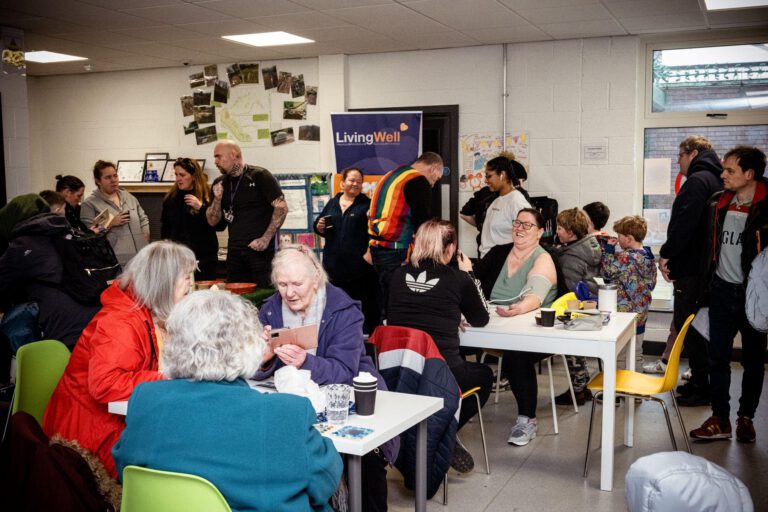
Local Trust reflected on the most effective types of gatherings, and as Big Local moved into the delivery phase Local Trust increased its emphasis on facilitating networking and peer support (Macmillan and Wells, 2024). National events with overnight stays (Big Local Connects) were established for partnership members from across all areas to meet and learn from each other, and network with Local Trust and its national support collaborators. Networking was the most mentioned aspect of the events in evaluations, with participants benefitting from informal spaces as much as organised workshops. The Connects events each attracted an average of 300 Big Local attendees, and while the Covid-19 pandemic forced it to move online in 2020, Connects at Home was equally successful.
In addition to regional and national events, Local Trust supported more focussed networks – role-specific networks and themed learning clusters – both of which were most successful when externally facilitated.
Role-specific networks included a chairs’ peer support network, which took an action learning approach to addressing challenges faced by partnership chairs and vice-chairs. A trusting and supportive environment was established to help participants learn from others, with some noting how it helped to see their Big Local as part of the wider programme. Another role-specific network was for Big Local workers, with access to a national network of community practitioners. Both these role-specific networks were run by external national organisations, thus broadening opportunities for connections, outside as well as within Big Local.
Learning clusters were launched in 2018, establishing groups of areas that could learn from each other and external specialists (who brought technical expertise and national connections). Clusters were based on topics identified as important to Big Local areas, like legacy, housing, coastal communities, youth exploitation and violence, digital inclusion, and mental health. Big Local reps or external providers facilitated clusters, fostering broader connections. Some included an overnight stay (allowing for additional informal networking) or a buddying system (supporting contact between sessions). Evaluation showed that 84 per cent of participants found sharing and networking across areas to be the most useful part of the clusters (Local Trust, 2021).
Participation in networks and learning clusters was broadened when they moved online during and following the Covid-19 pandemic in 2020. Lockdowns necessitated new forms of connection and Local Trust quickly organised Zoom licences and online training sessions for partnerships. This increased residents’ skills and confidence in connecting online and enabled those who hadn’t been able to attend in-person to engage. For example, a series of ‘Covid Conversations’ sessions attracted hundreds of participants. Access to Zoom also encouraged partnerships to hold online meetings and events in their areas, maintaining or creating new local relationships.
In 2020, Local Trust launched the Community Leadership Academy (CLA) to provide support and skills development for volunteers, to leave a legacy of more confident and better networked community leaders. Organisations were commissioned to provide leadership development training and support for residents involved in community engagement or project delivery across Big Local areas. Participants were invited to join the Community Leadership Fellowship Academy – a peer-to-peer network to continue learning and to practice and apply leadership skills (Terry et al., 2023).
Networking opportunities provided support and inspiration for partnerships, enabled collaboration between areas, and helped residents to build confidence and capabilities in making change. As a national resident-led programme that supported networking and invested in peer learning, Big Local provides a lot of learning.
Local Trust has explored how partnerships created networks and the importance of those networks to Big Local in another article.
Local Trust learnt that a range of networking opportunities were required to meet the needs of most people, most of the time. Some people preferred regional events with peers working in similar social-economic contexts, while others valued meeting people from across the country. The location of national events encouraged some and discouraged others from participating.
Local Trust found that networks were more valuable when members had something in common (like geography or topic). A structured process with skilled facilitation ensured that focus was maintained and everyone could fully participate, helping to avoid confident participants dominating or people feeling they shared more than they learnt.
Crucially, networking opportunities required substantial investment in time and money, but also in care and thought. Opportunities needed to reach target communities, be inclusive and welcoming, support people to overcome barriers to attend, use spaces that were conducive to people connecting, and treat people well. Above all, networking opportunities needed to be fun, as participants were volunteering their time.
Dobson, J., Gore, T., Graham, K., and Swade, K. (2022) ‘Unlocking the potential of Big Local partnerships: The role and impact of Locally Trusted Organisations’ (Local Trust and Sheffield Hallam University). Available at: shu.ac.uk/centre-regional-economic-social-research/publications/unlocking-the-potential-of-big-local-partnerships (Accessed 22 July 2025)
Hashmi, I., and Davis, J. (2025) ‘Learning from Big Local: what enables good relationships between resident-led groups and local government?‘. Available on Learning from Big Local. (Accessed 22 July 2025)
Local Trust (2018) ‘Review of the support offer‘. Available on Learning from Big Local. (Accessed 22 July 2025)
Local Trust (2021) ‘Learning cluster review report’. Unpublished internal document.
Local Trust (2023) ‘Evaluation of funders’ support for community-led change in Big Local – Internal report’. Unpublished internal document.
Macmillan, R., and Wells, P. (2024) ‘How was support delivered in the Big Local programme?‘ (Local Trust and Sheffield Hallam University). Available on Learning from Big Local. (Accessed 9 September 2025)
Terry, V., Usher, R., Rooney, K., Buckley, E., and Garforth, H. (2023) ‘Building community leadership: Learning from the Community Leadership Academy‘ (Local Trust, Institute for Voluntary Action Research, and Just Ideas). Available on Learning from Big Local. (Accessed 22 July 2025)
Wilson, M., McCabe, A., and Macmillan, R. (2022) ‘Building Big Local Futures: Building systems of community connection and control (Paper 1)’ (Local Trust, Third Sector Research Centre, and Sheffield Hallam University). Available at: ourbiggerstory.com/wp-content/uploads/2024/09/OBS-Building-connections-and-control-final-for-design_R5.pdf (Accessed 22 July 2025)
Wilson, M., McCabe, A., Ellis Paine, A., and Macmillan, R. (2023) ‘A delicate balance: national support provision in the Big Local programme’ (Local Trust, Third Sector Research Centre, Bayes Business School, and Sheffield Hallam University). Available at: ourbiggerstory.com/wp-content/uploads/2024/09/TSRC_A-delicate-balance_.-Full-report-2023_.pdf (Accessed 22 July 2025)
Wilson, M., Munro, E., Ellis Paine, A., Macmillan, R., Wells, P., and McCabe, A. (2024) ‘Understanding success in Big Local’ (Local Trust, Sheffield Hallam University, and Bayes Business School). Available at: ourbiggerstory.com/wp-content/uploads/2025/03/Our-Bigger-Study-What-is-Success.pdf (Accessed 22 July 2025)